OpenStack cloud fluffer growing faster than Linux

Two years in, and still not quite a cloud operating system
Analysis The OpenStack cloud controller, launched two years ago to the day by techies at NASA Ames Research Center and Rackspace Hosting, has come a long way in its infancy.
With Hewlett-Packard and Rackspace ramping up clouds based on the current "Essex" release, OpenStack is only just learning to walk. But it won't be long before companies looking to deploy private clouds – or to sell them as a service – will not only be looking for OpenStack to run, but to run well, run fast, and run networking in addition to compute and storage.
It's a lot to ask of a two-year-old, but OpenStack has a lot of mentors and advisors. If the OpenStack Foundation does what it is supposed to do, then it will be a meritocracy, not dominated by Rackspace, that will allow some of the best minds in the world to perfect a cloud operating system.
They may call it by different names, but the data center is the new server and a cloud operating system is exactly what Citrix Systems, Microsoft, Red Hat, and VMware have been seeking to build with their various software stacks.
The idea is to turn static physical hardware into malleable virtual hardware at the compute, storage, and network layers, allowing it to be programmatically controlled. Applications and their required software underpinnings can be puffed up in an instance and shuffled around inside a private cloud, or pushed out to a public cloud as workloads and economics dictate.
OpenStack logo
OpenStack started out two years ago as the marriage of the Nova compute controller that NASA developed for its internal Nebula cloud and the Swift storage controller and Ozone compute controller that Rackspace was working on for its own internal use. Neither NASA nor Rackspace wanted to be in the software business, but both felt compelled by the limitations of then-current cloud fabrics to throw both programmers and money at the problem.
The rocket computer scientists at NASA started working on Nova because of their frustration with the quasi-proprietary nature of the Eucalyptus cloud controller, which was maintained mostly by Eucalyptus Systems.
Rackspace wanted to transform itself from a simple hosting provider to a cloud provider, so it started work on cloudy storage under its Mosso subsidiary back in 2006. That effort got beefed up when Rackspace acquired Jungle Disk in October 2008, on the same day that it bought Slicehost, which had created its own compute cloud biz.
The Mosso cloud storage and Jungle Disk access code morphed into the Swift storage controller, which Rackspace currently uses in production. The Ozone compute controller, based on ideas from Slicehost, was underway when the NASA techies and the Rackspace techies decided to pool their efforts and at the same time foster an open source community to drive development of an alternative cloud control freak.
At the time, Eucalyptus was the early favorite as an alternative to VMware's "virtual data center operating system." It was embracing multiple hypervisors and virtual machine images to gain leverage over VMware and what would eventually become vSphere and vCloud Director. Canonical, the commercial entity behind Ubuntu Linux, embraced Eucalyptus and embedded it inside of its distro, and server makers fell all over themselves saying they were going to build Eucalyptus clouds.
Everyone talks about OpenStack now. That is, unless they are talking about CloudStack, the alternative now championed by Citrix Systems. Citrix left the OpenStack community (more or less) and open sourced CloudStack under an Apache license back in April. Citrix and the rest of the OpenStack community have a fundamental difference of opinion that cannot be resolved.
OpenStack, which is more or less driven by Rackspace at this point, wants to build a cloud fabric that has its own set of APIs. Citrix and the CloudStack community want to create an open source fabric that adheres to the API sets created by Amazon for its eponymous Web Services cloud. You can imagine that Rackspace would rather crawl through 500 miles of the west Texas desert than kowtow to Amazon, which pretty much rules the public cloud these days.

OpenStack ramps faster than Linux

Since OpenStack launched two years ago, a flurry of IT vendors and independents have rallied to its banner. Jim Curry, general manager of the Cloud Builders program at Rackspace and the man who spearheads the OpenStack efforts from inside Rackspace, says that the enthusiasm building around OpenStack rivals that of Linux in its early days.
Applied Micro X-Gene ARM block diagram
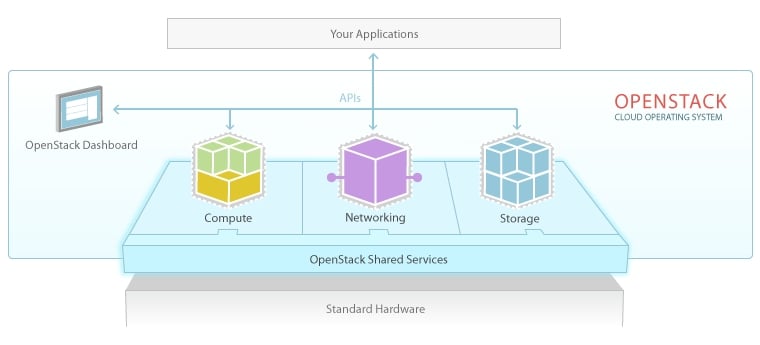
OpenStack: If it were only as easy as this picture makes it seem (click to enlarge)
Curry did a little math, and he tells El Reg that it took 828 weeks to get 180 companies contributing code to the Linux kernel, whereas OpenStack had lined up contributors from 166 companies in 84 weeks. In terms of actual code commits, Linux had 200 contributors by week 615 of its existence, while OpenStack had 206 contributors by week 84.
To show you how developer interest has grown, there were 75 people in attendance at the first OpenStack Design Summit in July 2010. There were more than 1,600 people at the event in April when the "Essex" release was launched.

From Austin to Diable to Essex

At the moment, there have been over 200,000 downloads from the OpenStack repository, and that doesn't count all of the versions that have been repackaged by Canonical, SUSE Linux, Piston Computing, and Stackops. There are over 100 commercial clouds running OpenStack today, including ones from AT&T, HP, Deutsche Telekom, DreamHost, Korea Telecom, NTT, and Internap.
And, of course, soon Rackspace itself will offer a commercial cloud. It is currently in the process of beta testing the "Essex" release in production. (The Swift controller has been used for years in production at Rackspace for the Cloud Files service; what is changing is the move to the Nova compute controller and all of the other tools that wrap around the two.)
The Essex release had 235 code contributors, according to Curry, and even though the OpenStack Foundation, formed late last year and moving towards taking over the steering of the various OpenStack projects that make up the cloud control freak.
Curry says that the foundation will take control in the next two to three months, when the trademarks and other intellectual property will be transferred to the foundation, and that the goal is for this to happen before the OpenStack Design Summit in October. The governance documents for the foundation have been drafted and are sufficiently rigorous for Red Hat to join up. OpenStack is searching for an executive director at the moment and is doing interviews.
Jim Curry, GM of OpenStack Cloud Builders at RackspaceJim Curry, GM of OpenStack Cloud Builders at Rackspace
"We used to manage the project, but we are now acting as a member of the community," says Curry.
In the wake of the initial code dump from NASA, Rackspace was pretty much the only code contributor to the project, but now Rackspace's contributions are down around 50 per cent – and that is against contributions that are two to three times as great as when the project was first started two years ago. So the amount of code coming out of Rackspace is actually growing, but that contributed by other community members is growing much faster.
"The rest of the community is taking responsibility for the project, and that is what we want. We didn't open source this because we wanted to control this," Curry says.
In fact, Curry says that Rackspace expect for the foundation to take control of OpenStack until 2013 or 2014, so if anything, getting it done by this October is early.
Incidentally, the OpenStack Foundation just announced in a blog post that individuals in the OpenStack community can now formally join the foundation and therefore have a say in nominating board members.

OpenStack: Folsom and beyond

With the Linux kernel and its related operating system layers in the late 1990s and early 2000s, each subsequent release was important because so much functionality was being added every time Linus Torvalds gave the go-ahead. Linux today is much more sophisticated and useful, but the changes are arguably not as jarring as they were, because Linux and the process by which it is created are both more mature.
As a two-year-old, OpenStack is still, in many ways, trying to code wings onto the airplane as the fuselage rockets down the runway towards liftoff. It is a fun time for OpenStack contributors, and this, says Curry, is one of the reasons why the ramp for OpenStack is steeper than that for Linux at the same point in its cycle.
"The promise of an open cloud is a very interesting problem to work on," says Curry. "We got into a market that clearly needed a solution."
It took a dot-com bust to really put the shine on Linux and take the bloom off Unix and proprietary machines.
The next release of OpenStack is code-named "Folsom," and it has just passed its third milestone, with the goal of getting it out the door in the last week of September. It will add Quantum virtual networking, Ceph block storage, and substantial enhancements to the Nova compute controller, the Glance virtual machine imaging system, Horizon management dashboard.
"Folsom is coming along well, and we have a lot of new things coming," says Curry. But speaking on a personal basis, not as someone in charge of OpenStack but as a member of the community, Curry wants the OpenStack community to slow down a bit.
"I am glad that all of these features are being added, but my personal focus would be to make this more usable," he says. "The speed of feature additions is not always conducive to ease of deployment and management."
That, ultimately, may be the other big selling point for OpenStack over other alternatives, aside from it being free if you are smart enough to support it by yourself (just like Linux). The Penguin was never going to be able to knock Windows off the desktop because of the overwhelming familiarity (and for many, contempt) that we all have with Windows as it has grown up on our desktops and moved into servers over the decades.
But in the cloud operating system racket, nothing is familiar because, quite honestly, so few companies are really doing anything more than server virtualization. OpenStack has an even chance of beating VMware vCloud, even if Citrix tries to go its own way with the Apache-licensed CloudStack and hitches its future on compatibility with AWS.
Microsoft is always a wild card because there are so many Windows servers out there and it can give away for free what others have to charge for. Red Hat is trying to do its own thing with OpenShift and CloudForms, but it may just give in, move to OpenStack once it matures, and ship a commercial-grade variant with support.
Year three promises to be interesting for OpenStack. That's for sure

Google's new cloud service said to be imminent

There's speculation that the Web giant may launch its cloud service during Google I/O -- putting it in competition with Amazon's existing service and Microsoft's rumored upcoming service.
by Dara Kerr
Talk has been circulating recently about Google building an Infrastructure as a Service cloud computing platform in the near future. Now, GigaOM is reporting that it's possible the Web giant could be launching this service as soon as next week during the Google I/O developers' conference in San Francisco.
The tech news site is also saying that several people familiar with Google's plans have confirmed that the company will also be offering its current app engine and storage with its forthcoming service.
The Web giant's platform will most likely compete with Amazon's EC2 cloud service, but it could also be up against a similar Infrastructure as a Service cloud computing offering that Microsoft is supposedly building.


Both Microsoft and Google already have software suites in the cloud, Microsoft with Office 365 and Google with Apps for Business; moving into Infrastructure as a Service territory could be a financial boost for both companies. According to GigaOM, Google's main target is actually Microsoft and its developer community. "The enterprise developer community is also one of Microsoft's biggest strengths, and Google wants to go after them," GigaOM writes. "In order to lure these enterprise developers, the company has focused heavily on making it easier to write, deploy and manage applications on its platform."
When CNET contacted Google for comment, its spokesperson said the company is not commenting on rumor or speculation.

Google, Microsoft head for cloud battle with Amazon

The 2 tech giants plan to pitch their cloud infrastructure platforms in direct competition to the e-tailer.

Amazon  is the leader in the cloud-computing space, thanks to the immense popularity of Amazon Web Services. The cloud-based infrastructure platform enables developers to create scalable Web-based software powered by the company's massive infrastructure.

Amazon competes primarily with Microsoft's Azure, Google's App Engine, Salesforce.com offerings such as Heroku and Force.com, and Rackspace.

However, Microsoft and Google offer cloud platform-as-a-servic​e offerings, which enable developers to run their apps on their servers, compared to Amazon's cloud infrastructure-as-a-​service offering that gives greater control of the entire virtual environment to developers. (Microsoft owns and publishes Top Stocks, an MSN Money site.)

Google and Microsoft are apparently planning to go up against Amazon by launching their cloud infrastructure platforms, which will compete more directly with Amazon's Elastic Computing Cloud. Amazon generates a significant portion of its revenue from Amazon Web Services, and is on track to generate roughly $2 billion from this business in 2012.

We expect Google's and Microsoft's focus on cloud offerings and their efforts to directly compete against Amazon will lead to a decline in Amazon's market share in the space. You can check out the impact of a slowdown in Amazon's revenue from cloud and other Web services on its value using this chart:

Amazon Cloud and Other Web Services Revenues
Cloud and other Web services account for around 3% of Amazon's total value. We currently have a $222 Trefis price estimate for Amazon, which stands near its market price.

NASA Drops Development for OpenStack Cloud Computing Software

Space agency NASA is withdrawing its participation with OpenStack Space agency NASA is withdrawing its participation with OpenStack
Space agency NASA is withdrawing its participation with OpenStack, the open source cloud organization it co-founded with web hosting company Rackspace, according to a report by DatacenterDynamics.

Since launching two years ago
, the OpenStack community of developers and cloud computing technologists have continued to improve on the open standard cloud computing software.
In more recent months, the open-source platform has seen a growing level of commercial adoption, drawing support from Dell, IBM, Cisco, HP, Yahoo!, and Red Hat.
In a presentation at Uptime Institute’s symposium on Tuesday, Karen Petraska, service executive for computing services at NASA’s CIO office, said the agency will scale back its development of the open-source platform now that it has started to see commercial adoption.
Petraska added that NASA is not interested in competing with commercial cloud companies, and would rather be a “smart consumer” of commercial cloud services.
In addition to reducing its work with OpenStack, NASA also said it will cease its developmental involvement with cloud infrastructure solution Nebula.
NASA’s move comes just a few weeks after its fellow OpenStack co-founder Rackspace revealed it will continue to build on its cloud investments like OpenStack to ramp up future revenues following a slightly disappointing first quarter.
Meanwhile, OpenStack continues to flourish in development, releasing its fifth version, Essex last month. The new platform is the culmination of contributions from  200 developers, and boasts 150 new features.
NASA’s Jet Propulsion Laboratory website was breached last November, which resulted in hackers being able to install malware, delete or steal private information, and take control of user accounts to access privilege sections of the network

Who needs cloud computing?

Google Drive launches
Some will have to wait to take Google's new offering for a test drive. (Google / April 24, 2012)


With all of the chatter around Google Drive and the like, you may be wondering whether you should have a cloud drive somewhere.
Some people live blissful digitally disconnected lives -- free of smartphones, free of Facebook, devoid of a digital photo album with snapshots of everything from their baby to their breakfast, no tangle of charging cables, no bytes of data to transfer or tap.
But if you're sending yourself emails just to get a PDF or photo from one device to another, you might need a cloud drive somewhere.
If you've ever been out living your life and thought, "I really could use that file off my computer at home," there's a cloud with your name on it.
The question is where. And that depends on what you need. Most services are basically storage lockers for your stuff -- documents, photos, videos. But some offer smarter features as well.
Right now, a number of services are giving users free space, from about 2 gigabytes up to 7 gigabytes. You could go around and just collect free space, or study aspects such as the features, the terms of service and privacy policies,  or the service's reliability before committing.
Here's a quick look at some of what's out there.
Microsoft SkyDrive -- This one gives you 7 gigabytes of free storage. There are apps for Mac and PC, plus apps for Windows Phone, iOS  and through the OneNote app for Android, according to the site.
Google Drive -- You get 5 GB free, upgradable to a terabyte for $49.99 a month. In addition to allowing you to access your digital content, the service, unlike the others, also allows users to  collaboratively create and edit documents or video, and facilitates sharing. There's an Android app available now, with an iOS app in the works, the company said.
Something to note: The company, which also makes a good chunk of its money through wrapping some of your content in related ads, told me that it has no plans to do that with your content in Google Drive.
Amazon CloudDrive -- If you have or create an Amazon account, you get 5 GB for free. Your account is upgradable to one terabyte for $1,000 a year. The service lets you connect as many as eight devices, which can include mobile devices, different computers, and different browsers on the same computer. Any digital music you buy from Amazon is stored in that virtual locker but doesn't count against your quota.
SugarSync -- Here, you get 5 GB free. Some difference are that you can email files into your SugarSync storage and share folders with passwords or permissions, and you can send files of any size.  The service also keeps the previous five versions of all your documents (and photos) for either your reference or recovery. But only the most recent version counts toward the storage limit. It has apps for iOS, Android, BlackBerry, Windows Phone, Symbian and Kindle Fire, as well as an Outlook plugin.
DropBox -- This service gives you 2 GB to start, with the ability to boost your storage by "earning" up to 16 additional GB for referring others to the service. With the Pro account you can earn up to 16 GB additional space for referring friends, or upgrade to a Pro account with up to 100 GB and 32 GB for referrals starts at $10 a month. DropBox also keeps a snapshot of every change you make over the last 30 days without affecting your storage limit. You can share specific files or entire folders with friends, colleagues or family. On the mobile front, it has apps for iOS, Android and BlackBerry.
Again, with any of these services, it's important to read and understand what the shared responsibilities and commitments are in the legal contracts you're accepting by hitting "agree."

Microsoft head: How 'the cloud' could save Europe

Europe's struggling economies could find themselves thrown a lifeline from the "cloud," according to Microsoft International's president Jean-Philippe Courtois.

Cloud computing -- where businesses access computing services from a centralized provider, rather than owning their own infrastructure -- could be the key to kick-starting Europe's struggling economies, Courtois told CNN.

The shift in technology is the biggest in the past decade, and can transform the way businesses can operate, he added.

"You don't need to buy any more of [that] huge IT equipment, because you are actually using a service, like how you use electricity," he said.

Instead of investing capital in IT infrastructure, businesses can now opt for a cloud computing solution in which they pay as they go. "You just pay for the service you use when you need it," Courtois said.
We call it the new world of work, because people don't all necessarily have to come together physically
Jean-Philippe Courtois, president of Microsoft International

This removes technological barriers that can hold back the small- and medium-sized businesses which are at the heart of the European economy.

"We see many small businesses jump on the cloud bandwagon right now, as opposed to the large companies, because they can ... compete with some big global players using an incredible technology for only a few euros a month. That is making a profound change, particularly in countries where the recession is pretty tough," he said.

"If you are a very small company today, you can have a much more visible and aggressive presence."

Cloud computing also allows for savings to be made by enabling workers in different locations to collaborate online, reducing paper waste and travel costs.

"We call it the new world of work, because people don't all necessarily have to come together physically," Courtois said.

As well as presenting opportunities for businesses, Courtois said cloud technology could allow governments to become more competitive. "When I go back to Europe, visiting Spain -- a very depressed economy -- we see some of the opportunity... to help governments rationalize their budget."

"If you look at predictions [for] the European economy, it doesn't look great at this point. But I'm very convinced again that the work we do is an enabler of economic transformations."

Rackspace Starts the Great OpenStack Migration

It's inching out with a production-ready OpenStack cloud based on Essex

BY MAUREEN O'GARA

Rackspace, which wants to be the "Linux of the cloud" mimicking the now billion-dollar-a-year Red Hat, said Monday that it's "drawing a line in the sand against cloud providers." Everyone agrees it has Amazon, particularly, and VMware, to a certain extent, in mind. However, what'll probably end up happening is that Red Hat, which has a prominent part in the open source OpenStack project that Rackspace started, becomes the "Linux of the cloud" because it's got all the pieces, or thinks it does, but that's another story. Anyway, Rackspace is inching out with a production-ready OpenStack cloud based on Essex, the fifth and best-yet release of the open source cloud platform put in train by Rackspace and NASA in the summer of 2010.
Rackspace CEO Louis Napier told a New York Times blog that he expects to have all his customers, by then perhaps 200,000 businesses, on some or all of an OpenStack system by summer.
The fight is supposed to come down to a duel between the proprietary Amazon APIs, now lauded as the de facto standard of public clouds, and the still immature but open source CloudStack APIs.
Rackspace says come May 1, in roughly two weeks time, it will begin providing customers with default access to widgetry that it's now got in "limited availability."
That includes:
  • Cloud Servers, the Essex-based EC2-like compute piece of OpenStack, a k a Nova, accessible through the new programmable OpenStack API for switching between OpenStack clouds or a new intuitive control panel.
  • A built-from-the-ground-up graphical Control Panel that allows server tagging to discriminate between production and development servers so they can be controlled in concert and has multi-region capabilities.
Rackspace says "limited availability" means customers can sign up now, the widgetry is reportedly production workload-ready, there are unspecified SLAs, 24x7 support and regular billing. It seems it could take Rackspace a few months to ensure a smooth ramp-up but the move is supposed to be imperceptible.
Rackspace, which has already got the S3-like Cloud Files storage, a k a Swift, will move all of its public, private and hybrid cloud to this widgetry.
It's also got stuff in "early access" defined as "production workload-ready but with limited support available, no service commitments and no billing.
They include:
  • OpenStack Cloud Databases (Project Red Dwarf) with API access to a massively scalable, highly available MySQL database with redundant SAN storage for high performance and automated management. Figure on Microsoft SQL Server and other databases too but maybe not from Rackspace. Amazon, of course, has the MySQL-derived Relational Data Service (RDS).
  • Single-view Cloud Monitoring of the infrastructure and applications based on Rackspace's acquisition of Cloudkick.
Lastly it's got early versions of products in "preview" looking for testers namely:
  • OpenStack Cloud Block Storage, like Amazon's Elastic Block Storage (EBS), but offering either solid state or lower-cost disk storage.
  • Cloud Networks, software-defined virtual networks for managing logically abstracted network services programmatically. IDC says Rackspace's Cloud Networks is "going to eliminate some of the hesitation businesses have around cloud adoption." Thank you Cisco et al.
Here's what it all looks like:
Rudimentary pricing will remain the same starting at $0.015 cents an hour for a Linux virtual server with 10GB of disk space and 256MB of RAM and $0.08 an hour for Windows.
Rackspace still has to say what the database, storage and networking will ultimately run.
HP, a chief OpenStack acolyte, won't have a beta take on the Essex platform memorialized in its HP Cloud Services until May 10 with no estimates, as of last week, on when it could have a production public cloud.
There will be OpenStack fragmentation, observers prophecy. HP won't return all the distinguishing tweaks it makes to the community.
Rackspace says on its web site that it's got more than 170,000 businesses and 60% of the Fortune 100 as customers.