Two years in, and still not quite a cloud operating system
By Timothy Prickett Morgan
Analysis The OpenStack cloud controller, launched two years ago to the day by techies at NASA Ames Research Center and Rackspace Hosting, has come a long way in its infancy.
With Hewlett-Packard and Rackspace ramping up clouds based on the
current "Essex" release, OpenStack is only just learning to walk. But it
won't be long before companies looking to deploy private clouds – or to
sell them as a service – will not only be looking for OpenStack to run,
but to run well, run fast, and run networking in addition to compute
and storage.
It's a lot to ask of a two-year-old, but OpenStack has a lot of
mentors and advisors. If the OpenStack Foundation does what it is
supposed to do, then it will be a meritocracy, not dominated by
Rackspace, that will allow some of the best minds in the world to
perfect a cloud operating system.
They may call it by different names, but the data center is the new
server and a cloud operating system is exactly what Citrix Systems,
Microsoft, Red Hat, and VMware have been seeking to build with their
various software stacks.
The idea is to turn static physical hardware into malleable virtual
hardware at the compute, storage, and network layers, allowing it to be
programmatically controlled. Applications and their required software
underpinnings can be puffed up in an instance and shuffled around inside
a private cloud, or pushed out to a public cloud as workloads and
economics dictate.
OpenStack started out two years ago as the marriage of the Nova
compute controller that NASA developed for its internal Nebula cloud and
the Swift storage controller and Ozone compute controller that
Rackspace was working on for its own internal use. Neither NASA nor
Rackspace wanted to be in the software business, but both felt compelled
by the limitations of then-current cloud fabrics to throw both
programmers and money at the problem.
The
rocket computer scientists at NASA started
working on Nova because of their frustration with the quasi-proprietary
nature of the Eucalyptus cloud controller, which was maintained mostly
by Eucalyptus Systems.
Rackspace wanted to transform itself from a simple hosting provider
to a cloud provider, so it started work on cloudy storage under its
Mosso subsidiary back in 2006. That effort got beefed up when Rackspace acquired Jungle Disk in October 2008, on the same day that it bought Slicehost, which had created its own compute cloud biz.
The Mosso cloud storage and Jungle Disk access code morphed into the
Swift storage controller, which Rackspace currently uses in production.
The Ozone compute controller, based on ideas from Slicehost, was
underway when the NASA techies and the Rackspace techies decided to pool
their efforts and at the same time foster an open source community to
drive development of an alternative cloud control freak.
At the time, Eucalyptus was the early favorite as an alternative to
VMware's "virtual data center operating system." It was embracing
multiple hypervisors and virtual machine images to gain leverage over
VMware and what would eventually become vSphere and vCloud Director.
Canonical, the commercial entity behind Ubuntu Linux, embraced
Eucalyptus and embedded it inside of its distro, and server makers fell
all over themselves saying they were going to build Eucalyptus clouds.
Everyone talks about OpenStack now. That is, unless they are talking
about CloudStack, the alternative now championed by Citrix Systems.
Citrix left the OpenStack community (more or less) and open sourced
CloudStack under an Apache license
back in April. Citrix and the rest of the OpenStack community have a fundamental difference of opinion that cannot be resolved.
OpenStack, which is more or less driven by Rackspace at this point,
wants to build a cloud fabric that has its own set of APIs. Citrix and
the CloudStack community want to create an open source fabric that
adheres to the API sets created by Amazon for its eponymous Web Services
cloud. You can imagine that Rackspace would rather crawl through 500
miles of the west Texas desert than kowtow to Amazon, which pretty much
rules the public cloud these days.
OpenStack ramps faster than Linux
Since OpenStack launched two years ago, a flurry of IT vendors and
independents have rallied to its banner. Jim Curry, general manager of
the Cloud Builders program at Rackspace and the man who spearheads the
OpenStack efforts from inside Rackspace, says that the enthusiasm
building around OpenStack rivals that of Linux in its early days.

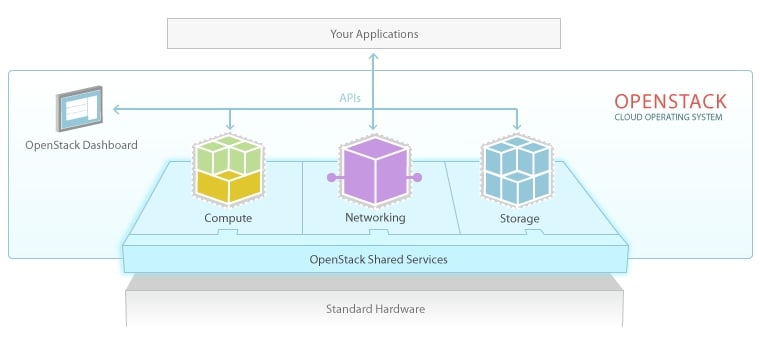
OpenStack: If it were only as easy as this picture makes it seem (click to enlarge)
Curry did a little math, and he tells
El Reg that it took 828
weeks to get 180 companies contributing code to the Linux kernel,
whereas OpenStack had lined up contributors from 166 companies in 84
weeks. In terms of actual code commits, Linux had 200 contributors by
week 615 of its existence, while OpenStack had 206 contributors by week
84.
To show you how developer interest has grown, there were 75 people in
attendance at the first OpenStack Design Summit in July 2010. There
were more than 1,600 people at the event in April when the "Essex"
release was launched.
From Austin to Diable to Essex
At the moment, there have been over 200,000 downloads from the
OpenStack repository, and that doesn't count all of the versions that
have been repackaged by Canonical, SUSE Linux, Piston Computing, and
Stackops. There are over 100 commercial clouds running OpenStack today,
including ones from AT&T, HP, Deutsche Telekom, DreamHost, Korea
Telecom, NTT, and Internap.
And, of course, soon Rackspace itself will offer a commercial cloud.
It is currently in the process of beta testing the "Essex" release in
production. (The Swift controller has been used for years in production
at Rackspace for the Cloud Files service; what is changing is the move
to the Nova compute controller and all of the other tools that wrap
around the two.)
The Essex release had 235 code contributors, according to Curry, and even though the OpenStack Foundation, formed late last year and moving towards taking over the steering of the various OpenStack projects that make up the cloud control freak.
Curry says that the foundation will take control in the next two to
three months, when the trademarks and other intellectual property will
be transferred to the foundation, and that the goal is for this to
happen before the OpenStack Design Summit in October. The governance documents for the foundation have been drafted
and are sufficiently rigorous for Red Hat to join up. OpenStack is
searching for an executive director at the moment and is doing
interviews.

Jim Curry, GM of OpenStack Cloud Builders at Rackspace
"We used to manage the project, but we are now acting as a member of the community," says Curry.
In the wake of the initial code dump from NASA, Rackspace was pretty
much the only code contributor to the project, but now Rackspace's
contributions are down around 50 per cent – and that is against
contributions that are two to three times as great as when the project
was first started two years ago. So the amount of code coming out of
Rackspace is actually growing, but that contributed by other community
members is growing much faster.
"The rest of the community is taking responsibility for the project,
and that is what we want. We didn't open source this because we wanted
to control this," Curry says.
In fact, Curry says that Rackspace expect for the foundation to take
control of OpenStack until 2013 or 2014, so if anything, getting it done
by this October is early.
Incidentally, the OpenStack Foundation
just announced in a blog post
that individuals in the OpenStack community can now formally join the
foundation and therefore have a say in nominating board members.
OpenStack: Folsom and beyond
With the Linux kernel and its related operating system layers in the
late 1990s and early 2000s, each subsequent release was important
because so much functionality was being added every time Linus Torvalds
gave the go-ahead. Linux today is much more sophisticated and useful,
but the changes are arguably not as jarring as they were, because Linux
and the process by which it is created are both more mature.
As a two-year-old, OpenStack is still, in many ways, trying to code
wings onto the airplane as the fuselage rockets down the runway towards
liftoff. It is a fun time for OpenStack contributors, and this, says
Curry, is one of the reasons why the ramp for OpenStack is steeper than
that for Linux at the same point in its cycle.
"The promise of an open cloud is a very interesting problem to work
on," says Curry. "We got into a market that clearly needed a solution."
It took a dot-com bust to really put the shine on Linux and take the bloom off Unix and proprietary machines.
The next release of OpenStack is code-named "Folsom," and it has just
passed its third milestone, with the goal of getting it out the door in
the last week of September. It will add Quantum virtual networking,
Ceph block storage, and substantial enhancements to the Nova compute controller, the
Glance virtual machine imaging system,
Horizon management dashboard.
"Folsom is coming along well, and we have a lot of new things
coming," says Curry. But speaking on a personal basis, not as someone in
charge of OpenStack but as a member of the community, Curry wants the
OpenStack community to slow down a bit.
"I am glad that all of these features are being added, but my
personal focus would be to make this more usable," he says. "The speed
of feature additions is not always conducive to ease of deployment and
management."
That, ultimately, may be the other big selling point for OpenStack
over other alternatives, aside from it being free if you are smart
enough to support it by yourself (just like Linux). The Penguin was
never going to be able to knock Windows off the desktop because of the
overwhelming familiarity (and for many, contempt) that we all have with
Windows as it has grown up on our desktops and moved into servers over
the decades.
But in the cloud operating system racket, nothing is familiar
because, quite honestly, so few companies are really doing anything more
than server virtualization. OpenStack has an even chance of beating
VMware vCloud, even if Citrix tries to go its own way with the
Apache-licensed CloudStack and hitches its future on compatibility with
AWS.
Microsoft is always a wild card because there are so many Windows
servers out there and it can give away for free what others have to
charge for. Red Hat is trying to do its own thing with OpenShift and
CloudForms, but it may just give in, move to OpenStack once it matures,
and ship a commercial-grade variant with support.
Year three promises to be interesting for OpenStack. That's for sure
 By Barb Darrow